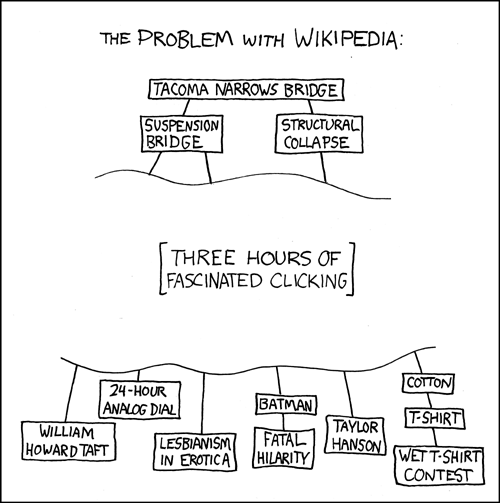
...is this.
You're telling me. I went there yesterday to look some stuff for a repost I have to write; I landed up on a page about a goddess I'd been meaning to read up on for some time!
Personally, I have my suspicions about Wikipedia. You do a search on any freaking topic in the universe, and the Wikipedia page will be there in the top five results. So I wonder if they've actually done something to make it turn out that way.
We all know it can be done. I mean, people fixed their blogs in a way so that if you typed in "miserable failure" in Google and clicked on the "I'm feeling lucky" button, you would get George W. Bush's biography in the White House website. Earlier this year, Google decided to step in and fix it so that if you try it now, you get this article instead!!!
My point is, like the BBC article says, it apparently doesn't need too many people to make a particular website top the searches. So what's to stop the Wikipedia crowd from doing so?
The only loophole that I can see in my latest conspiracy theory is this: that's an awful lot of articles they'd have to sit and fix !!!
The other problem that Wikipedia might occasionally have is its accuracy. Since pretty much anyone and everyone can create and/or edit articles there, you really don't know how accurate someof the stuff there is. I'm sure they have a staff to try and keep an eye on stuff, but when you have a site on pretty much everything open to pretty much the whole world for editing, I'm pretty darn sure there are going to be occassions incorrect stuff gets published.
Of course, that doesn't change the fact that Wikipedia is still the first place I head to whenever I need to look up something!!!
Update:
I have no idea if it's a coincidence or irony or what, but ever since I wrote this entry, Wikipedia hasn't featured in the top ten results of 90% of the searches I've done. Talk about freaky! (25/02/07)
You're telling me. I went there yesterday to look some stuff for a repost I have to write; I landed up on a page about a goddess I'd been meaning to read up on for some time!
Personally, I have my suspicions about Wikipedia. You do a search on any freaking topic in the universe, and the Wikipedia page will be there in the top five results. So I wonder if they've actually done something to make it turn out that way.
We all know it can be done. I mean, people fixed their blogs in a way so that if you typed in "miserable failure" in Google and clicked on the "I'm feeling lucky" button, you would get George W. Bush's biography in the White House website. Earlier this year, Google decided to step in and fix it so that if you try it now, you get this article instead!!!
My point is, like the BBC article says, it apparently doesn't need too many people to make a particular website top the searches. So what's to stop the Wikipedia crowd from doing so?
The only loophole that I can see in my latest conspiracy theory is this: that's an awful lot of articles they'd have to sit and fix !!!
The other problem that Wikipedia might occasionally have is its accuracy. Since pretty much anyone and everyone can create and/or edit articles there, you really don't know how accurate someof the stuff there is. I'm sure they have a staff to try and keep an eye on stuff, but when you have a site on pretty much everything open to pretty much the whole world for editing, I'm pretty darn sure there are going to be occassions incorrect stuff gets published.
Of course, that doesn't change the fact that Wikipedia is still the first place I head to whenever I need to look up something!!!
Update:
I have no idea if it's a coincidence or irony or what, but ever since I wrote this entry, Wikipedia hasn't featured in the top ten results of 90% of the searches I've done. Talk about freaky! (25/02/07)